Header with photo

Header with photo
Showing posts with label three turn. Show all posts

Thursday, 6 February 2014

You Be the Judge, er, Technical Specialist: Evaluating the Key Points of the Finnstep at ISU Four Continents Figure Skating Championships 2014

The purpose of this post is to give readers the opportunity to apply their knowledge of the key points of the Finnstep in reviewing the top three teams at the ISU Four Continents Figure Skating Championships 2014. We have provided videos of the Finnsteps in their entirety along with gifs of their key points. We have reiterated what you should be looking for in each of the key points and also identified common errors based on what we have seen this season. We encourage you to slow the videos down and pause them at moments of weight transfer to judge correct blade placement or at the commencement of rotation in the twizzles to determine if the correct number of rotations have been completed.


Ideally, we would have access to the footage used by the technical panel in evaluating these pattern dances, but we still think this exercise can be valuable in understanding what is happening in the key points.

Here is the protocol for this segment of the event.

And here are the videos of the Finnsteps:

Piper Gilles/Paul Poirier:


Madison Hubbell/Zachary Donohue:


Alexandra Aldridge/Daniel Eaton:


Finnstep Section I

Key Point 1
Lady & Man Steps 1 & 4 (XB-RF, XB-LF) 
and Lady Step 12 (LFO Tw1½)

You are looking for each partner to cross the right foot behind the left (below the knee) for the first step and then the left foot behind the right (again below the knee) for the fourth step. Soon after (step 12) the female partner enters into 1.5 twizzles from a left forward outside entry edge.
Mistakes on this key point usually occur on step 12, the lady’s twizzle of 1.5 rotations entered into on a left forward outside edge. This twizzle has to be performed very quickly according to the timing rules of this pattern and thus it is easy to lose balance on this step.

Piper Gilles/Paul Poirier:


Madison Hubbell/Zachary Donohue:


Alexandra Aldridge/Daniel Eaton:


Key Point 2
Lady Steps 20-21
(XB-LBO, XF-RBI/RBI Tw1½/RFO)

You are looking for the female partner to cross her left foot behind her right foot (below the knee) on a back outside edge and then cross her right foot in front of her left foot (also below the knee) on a back inside edge. Errors on this key point most commonly occur on the next part where the female partner twizzles 1.5 rotations entering on that same right forward inside edge and exiting on a right forward outside edge. It is usually the exit edge not being a clear outside edge that causes the key point to be missed and thus the level to be reduced.

Piper Gilles/Paul Poirier:


Madison Hubbell/Zachary Donohue:


Alexandra Aldridge/Daniel Eaton:


Key Point 3
Man Steps 20-21
(XB-LFI, RFO-Sw3/RBI Tw1/RBI)

You are looking for the male partner to cross his left foot behind his right on a forward inside edge and then cross his right foot in front of his left and then enter into a swing three turn  on a forward outside edge, exiting this turn on a right back inside edge. This edge becomes the entry edge for the single twizzle that follows, and the male partner exits this twizzle on the same right back inside edge. Errors on this key point most often occur due to the man not showing a clear inside edge on the cross step (he either hits a flat or shows an outside edge) or on the exit of the twizzle.

Piper Gilles/Paul Poirier:


Madison Hubbell/Zachary Donohue:


Alexandra Aldridge/Daniel Eaton:


Finnstep Section II

Key Point 1
Lady Steps 32 & 33 (LFO Sw-ClCho, 
RBI/RBO/RBO Tw1½/RFI slide into stop)


You are looking for the female partner to move forward on her left foot on an outside edge and swing her right leg forward and step onto a right back inside edge (swing closed choctaw on left forward outside edge). The female partner then changes to a right back outside edge which is the entry edge for the 1.5 twizzle. She exits this twizzle on a right forward inside edge and slides to a halt on this edge. Errors on this key point are likely to occur on the exit edge of the swing closed choctaw: sometimes the skater fails to step down on a clear inside edge on the exit. An error may also occur on the twizzle, with the skater not showing continuous rotation.

Piper Gilles/Paul Poirier:


Madison Hubbell/Zachary Donohue:


Alexandra Aldridge/Daniel Eaton:


Key Point 2
Man Steps 32 to 33c (LFO Sw-ClCho, RBI 
OpMo, LFI, RFI/RFI Tw1/RFI slide into 
stop)

You are looking for the male partner to move forward on his left foot on an outside edge and swing his right leg forward and step onto a right back inside edge (swing closed choctaw on left forward outside edge). The male partner then performs an open mohawk on this same right back inside edge, bringing the left foot in front of his right and placing that left foot on a forward inside edge. He then steps onto his right forward inside edge and performs a single twizzle, exiting on a right forward inside edge and sliding to a halt on this edge. Errors on this key point are likely to occur on the exit edge of the swing closed choctaw: sometimes the skater fails to step down on a clear inside edge on the exit. An error may also occur on the twizzle, with the skater not showing continuous rotation.

Piper Gilles/Paul Poirier:


Madison Hubbell/Zachary Donohue:


Alexandra Aldridge/Daniel Eaton:


Key Point 3
Lady & Man Steps 64 & 65 (LFI XBClCho, RBO3/RFI Tw1½)

Both partners use  left forward inside entry edges and bring their right legs behind their left and cross the right foot behind the left foot on a back outside edge (LFI XBClCho). On this same right back outside edge they each perform a three turn with the free leg extended. They then bring the free leg in for the twizzle of 1.5 rotations. Errors on this step commonly occur on the weight transfer in the choctaw, with one or both partners not placing the right foot on a clear outside edge.

Piper Gilles/Paul Poirier:


Madison Hubbell/Zachary Donohue:


Alexandra Aldridge/Daniel Eaton:


Based on these videos and gifs, how would you assess the key points of the top three teams at the 2014 ISU Four Continents Championships? Let us know in the comments section!

Tuesday, 4 February 2014

More on Finnstep Key Points: A Look Back at the Pattern Dances of the 2014 European Championships

In this entry we will continue to familiarize you with the Finnstep by reviewing key points as performed in the Short Dance of the European Figure Skating Championships 2014. We have reiterated what you should be looking for in each of the key points and also identified common errors based on what we have seen this season. In addition to this, we have created gifs of the key points of the top three teams in the Short Dance and identified where teams missed key points or where they could have missed them. The purpose of this exercise is to show viewers how to identify key points and understand how the criteria for each key point is met. This includes identifying times when an edge may not be very clear thus resulting in different technical panels coming to different conclusions. We are discussing these key points based on what we see and we acknowledge that we do not have access to the same footage the technical panel reviews. That means that we do not always have the desired angle for each key point or consistency in the angles from which each key point is shown (the angle sometimes differs from team to team) and the video quality is not always great, thus, we do not make our claims with absolute certainty, but we have tried to explain the key points and errors based on the footage we have available to us, which we believe is sufficient to warrant a discussion. We have also included stills to show exact moments but we recommend viewing these alongside the key points in motion to get an idea of how the blade, ankle, and leg will look when on a flat, an inside edge, and an outside edge. In this post we are just covering what the technical panel looks for in assessing key points.

Here is the protocol.

And here are the short dances:

Cappellini/Lanotte:


Ilinykh/Katsalapov:


Coomes/Buckland:


Finnstep Section I
*Key Point 1
Lady & Man Steps 1 & 4 (XB-RF, XB-LF) 
and Lady Step 12 (LFO Tw1½)

You are looking for each partner to cross the right foot behind the left (below the knee) for the first step and then the left foot behind the right (again below the knee) for the fourth step. Soon after (step 12) the female partner enters into 1.5 twizzles from a left forward outside entry edge.
Mistakes on this key point usually occur on step 12, the lady’s twizzle of 1.5 rotations entered into on a left forward outside edge. This twizzle has to be performed very quickly according to the timing rules of this pattern and thus it is easy to lose balance on this step.

Cappellini/Lanotte:


Ilinykh/Katsalapov:


Coomes/Buckland:

Coomes/Buckland did not receive credit for this key point. The problem appears to occur on step 12, the lady’s LFO 1.5 twizzle (second gif). The camera cuts away during this step making it difficult to count rotation, so we recommend looking at the starting position of the blade on the left foot (where the blade is when it begins the rotation) and thinking of where it must end up to complete 1.5 turns. We have a screen capture of the moment we believe Coomes began her rotation and it appears that her blade is oriented a little bit left or counter-clockwise of where it should be at the start of the twizzle and thus the twizzle was a bit short of the 1.5 rotations. For comparison’s sake, we have also included screen caps of Cappellini’s and Ilinykh’s respective start positions for their twizzles, for which they received credit. Unfortunately the camera angle does not allow us to see the position of the blade at the conclusion of the step so we can only judge based on the position of the blade at the commencement of rotation and the position of the body at the completion of rotation.


Coomes/Buckland:


 Cappellini/Lanotte:


Ilinykh/Katsalapov:


Key Point 2
Lady Steps 20-21
(XB-LBO, XF-RBI/RBI Tw1½/RFO)

You are looking for the female partner to cross her left foot behind her right foot (below the knee) on a back outside edge and then cross her right foot in front of her left foot (also below the knee) on a back inside edge. Errors on this key point most commonly occur on the next part where the female partner twizzles 1.5 rotations entering on that same right forward inside edge and exiting on a right forward outside edge. It is usually the exit edge not being a clear outside edge that causes the key point to be missed and thus the level to be reduced.

All three teams received credit for this key point.

Cappellini/Lanotte:


Ilinykh/Katsalapov:


Coomes/Buckland:


Key Point 3
Man Steps 20-21
(XB-LFI, RFO-Sw3/RBI Tw1/RBI)

You are looking for the male partner to cross his left foot behind his right on a forward inside edge and then cross his right foot in front of his left and then enter into a swing three turn  on a forward outside edge, exiting this turn on a right back inside edge. This edge becomes the entry edge for the single twizzle that follows, and the male partner exits this twizzle on the same right back inside edge. Errors on this key point most often occur due to the man not showing a clear inside edge on the cross step (he either hits a flat or shows an outside edge) or on the exit of the twizzle.

Cappellini/Lanotte:

Cappellini/Lanotte did not receive credit for this key point due to a timing issue. Lanotte is late entering into his twizzle and thus does not hold this step for the correct number of beats.


Ilinykh/Katsalapov:


Coomes/Buckland:

Coomes/Buckland did not receive credit for this key point. Buckland’s rotation in the twizzle is not continuous: he appears to do two three turns rather than a clean twizzle. 


Finnstep Section II

Key Point 1
Lady Steps 32 & 33 (LFO Sw-ClCho, 
RBI/RBO/RBO Tw1½/RFI slide into stop)


You are looking for the female partner to move forward on her left foot on an outside edge and swing her right leg forward and step onto a right back inside edge (swing closed choctaw on left forward outside edge). The female partner then changes to a right back outside edge which is the entry edge for the 1.5 twizzle. She exits this twizzle on a right forward inside edge and slides to a halt on this edge. Errors on this key point are likely to occur on the exit edge of the swing closed choctaw: sometimes the skater fails to step down on a clear inside edge on the exit. An error may also occur on the twizzle, with the skater not showing continuous rotation.


Cappellini/Lanotte:


Ilinykh/Katsalapov:


Coomes/Buckland:


Key Point 2
Man Steps 32 to 33c (LFO Sw-ClCho, RBI 
OpMo, LFI, RFI/RFI Tw1/RFI slide into 
stop)

You are looking for the male partner to move forward on his left foot on an outside edge and swing his right leg forward and step onto a right back inside edge (swing closed choctaw on left forward outside edge). The male partner then performs an open mohawk on this same right back inside edge, bringing the left foot in front of his right and placing that left foot on a forward inside edge. He then steps onto his right forward inside edge and performs a single twizzle, exiting on a right forward inside edge and sliding to a halt on this edge. Errors on this key point are likely to occur on the exit edge of the swing closed choctaw: sometimes the skater fails to step down on a clear inside edge on the exit. An error may also occur on the twizzle, with the skater not showing continuous rotation.

Cappellini/Lanotte:

Cappellini/Lanotte did not receive credit for this key point due to a timing issue. Lanotte is late entering into his twizzle and thus does not hold this step for the correct number of beats.


Ilinykh/Katsalapov:


Coomes/Buckland:


Key Point 3
Lady & Man Steps 64 & 65 (LFI XBClCho, RBO3/RFI Tw1½)

Both partners use  left forward inside entry edges and bring their right legs behind their left and cross the right foot behind the left foot on a back outside edge (LFI XBClCho). On this same right back outside edge they each perform a three turn with the free leg extended. They then bring the free leg in for the twizzle of 1.5 rotations. Errors on this step commonly occur on the weight transfer in the choctaw, with one or both partners not placing the right foot on a clear outside edge.

Cappellini/Lanotte:


Cappellini/Lanotte received credit for this key point, but it may have been a close call. Ideally we would like to view a closer shot of this step, but from the orientation of her leg and boot, it appears Cappellini is on a bit of a flat at the moment of the weight transfer, captured in this picture. Another technical panel may not have given them credit for this key point.


Ilinykh/Katsalapov:


Ilinykh/Katsalapov did not receive credit for this key point. The three turn and 1.5 twizzle appear to have been clean, so the mistake was likely on the choctaw portion of this key point. Unfortunately Ilinykh’s boot and blade are somewhat obscured by her free foot in this picture, but judging from the orientation of her leg and what we can see of her boot, she likely was not on a clear outside edge.


Coomes/Buckland:


Coomes/Buckland received credit for this key point. Unfortunately we do not have an ideal angle to view their blades, but from what we can see, their thighs and legs are oriented in a way that suggests they were on outside edges.


How did you feel about the calls for the Finnstep at this event? Let us know in the comments section!


Thursday, 5 December 2013

The Fun Steps of the Finnstep: Identifying Key Points in this Season's Pattern Dance

The compulsory pattern for the senior ice dancers for the 2012/2013 season is the Finnstep. This compulsory pattern consists of 70 steps and is based on the 1995 Original Dance of legendary Finnish ice dance team, Susanna Rahkamo and Petri Kokko:


Basic information on the key points and assignment of levels for the Finnstep can be found on pages 13 and 14 of the Handbook for Technical Panels 2013 with a more detailed discussion found within pages 16-20. Please see ISU Communication #1497 as well, found here

And here are diagrams of the step patterns: 

Man's steps 
Lady's steps 

Please see also the Handbook for Officials on Pattern Dances.

In accordance with the rules outlined by the ISU, this dance, which is based in ballroom quickstep, should be “fun, fast” and “light”, with “crisp and tidy timing as well as footwork”, with the accent at the beginning of the beat rather than just on the beat. This dance calls for erect (“very upright, almost stiff”) posture and a contrast between “the longer steps with strong, well rounded, deep edges” and “the crisp light steps, toe steps and hops (small jumps without rotation)” to fully express its character. 

Below we have described what is going on in the key points. In Section II, key points 1 and 2 are based on the steps of the lady and man respectively, but they are happening simultaneously and the first step is the same for both partners so we included a description of what the team is doing as set-up for each of these key points to help you better identify the steps. 

RFI=right forward inside edge 
RFO= right forward outside edge 
LFI=left forward inside edge 
LFO= left forward outside edge 
 XF=cross step in front (below the skating knee) 
XB= cross step behind (below the skating knee) 
Tw=twizzle 
Sw3=swing three turn 
RBO3=three turn executed on a right back outside edge 
Sw-ClCho=swing closed choctaw 
XBClCho=closed choctaw with free foot crossed behind the skating foot (below the knee) 
OpMo=open mohawk 

Please refer to the previous entry for more information on turns and edges.

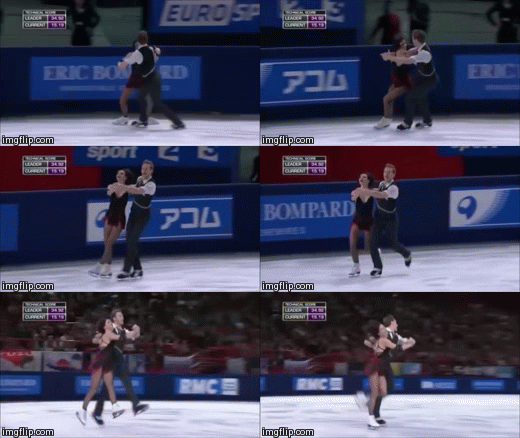
We have included gifs of the Finnstep pattern of Pechalat & Bourzat from Trophee Eric Bompard 2013 for which they received two level 4s. 


Remember that levels are given for correct edges, turns and timing. Key Points 2 and 3 of the first section of the pattern happen simultaneously, thus one video is provided for both. This is also the case for Key Points 1 and 2 of the second section of the pattern.


Finnstep Section I 

Key Point 1 Lady & Man Steps 1 & 4 (XB-RF, XB-LF) and Lady Step 12 (LFO Tw1½) 
Each partner crosses the right foot behind the left for the first step and the left foot behind the right for the fourth step. For step 12, the lady enters on a left forward outside edge into 1.5 twizzles.


Key Point 2 Lady Steps 20-21 (XB-LBO, XF-RBI/RBI Tw1½/RFO) 
The female partner crosses her left foot behind her right foot on a back outside edge and when this foot touches down she immediately picks up the right foot to cross it in front of her left foot on a back inside edge. Immediately following these steps, you see the female partner twizzle 1.5 rotations entering on that same right forward inside edge and exiting on a right forward outside edge. 


Key Point 3 Man Steps 20-21 (XB-LFI, RFO-Sw3/RBI Tw1/RBI)
The male partner crosses his left leg behind his right on a forward inside edge and as soon as he gets on this edge he brings the right leg up and crosses in front of his left without touching the right foot down on the ice before moving it back to its regular alignment and setting it down on a forward outside edge. On this same forward outside edge, the male partner completes a swing three turn, exiting this turn on a back inside edge. This edge becomes the entry edge for the single twizzle that follows, and the male partner exits this twizzle on the same right back inside edge. 


Finnstep Section II 


Key Point 1 Lady Steps 32 & 33 (LFO Sw-ClCho, RBI/RBO/RBO Tw1½/RFI slide into stop)
The team comes out of the corner and both skaters get onto their left forward outside edges and swing their right legs forward and step onto right back inside edges (swing closed choctaw on left forward outside edge). The female partner then changes to a right back outside edge which is the entry edge for the 1.5 twizzle. She exits this twizzle on a right forward inside edge and slides to a halt on this edge. 

Key Point 2 Man Steps 32 to 33c (LFO Sw-ClCho, RBI OpMo, LFI, RFI/RFI Tw1/RFI slide into stop) 
The team comes out of the corner and both skaters get onto their left forward outside edges and swing their right legs forward and step onto right back inside edges (swing closed choctaw on left forward outside edge). The male partner then performs an open mohawk on this same right back inside edge, bringing the left foot in front of his right and placing that left foot on a forward inside edge. He then steps onto his right forward inside edge and performs a single twizzle, exiting on a right forward inside edge and sliding to a halt on this edge. 


Key Point 3 Lady & Man Steps 64 & 65 (LFI XBClCho, RBO3/RFI Tw1½) 
This step is performed in the corner. They glide on their left forward inside edges and bring their right legs behind their left and cross the right foot behind the left foot on a back outside edge (LFI XBClCho). On this same right back outside edge they each perform a three turn with the free leg extended. They then bring the free leg in for the twizzle of 1.5 rotations.


Some brief notes on quality: Note how crisp and clean Pechalat/Bourzat's edges are throughout this dance. There is very little snow flying up from their blades. Note also how strong their posture is and how close together they skate this pattern, with excellent unison and good ice coverage. This was a strong Finnstep all around.